Catching the fleeting scenes of many splendored life
'Look closely. The beautiful may be small' — Kant

Showing posts with label Insects. Show all posts

1 April 2014

Dragonflies. Crimson Marsh Glider (Trithemis aurora) and Violet Dropwing (Trithemis annulata)

The Violet Dropwing, Trithemis annulata, is a species of dragonfly in family Libellulidae.
It is found in Algeria, Angola, Benin, Botswana, Burkina Faso, Cameroon, Chad, the Democratic Republic of the Congo, Ivory Coast, Egypt, Ethiopia, France, Gambia, Ghana, Greece, Guinea, Israel, Kenya, Liberia, Madagascar, Malawi, Mali, Mauritius, Morocco, Mozambique, Namibia, Nigeria, Réunion, Senegal, Sierra Leone, Somalia, South Africa, Sudan, Tanzania, Togo, Uganda, Zambia, Zimbabwe, and possibly Burundi. It was also recently recorded in the Maltese islands in 2005 and found breeding in 2007.

Crimson Marsh Glider (Trithemis aurora) female on dry stalk. (by-nc-nd)

26 March 2014

Red-veined Darter, Nomad (Sympetrum fonscolombii) Male

Red-veined Darter, Nomad (Sympetrum fonscolombii) male on a dry stem.
 (© LightColourShade. All rights reserved)

17 February 2014

Clouded Yellow (Colias croceu), Large / Cabbage White (Pieris brassicae)

Clouded Yellow (Colias croceus) is a small butterfly of the Pieridae family. The upper side is golden to orange yellow with a broad black margin on all four wings and a black spot near the centre forewing. The underside lacks the black borders and is lighter, with a more greenish tint, particularly on the forewings. Females differ from the males in having yellow spots along the black borders on the upper side. Like all Colias species they never open their wings at rest.

Clouded Yellow (Colias croceu) on Dittrichia viscosa (False Yellowhead) flower. (by-nc-nd)

26 November 2013

Dragonflies. Red-veined Darter, Nomad (Sympetrum fonscolombii) female

The Red-veined Darter or Nomad (Sympetrum fonscolombii) is a dragonfly of the genus Sympetrum. It is widespread in southern Europe and from the 1990s onwards also in northwest Europe, including Britain and Ireland.

Red-veined Darter (Sympetrum fonscolombii) female.
(© LightColourShade. All rights reserved)

13 November 2013

Dragonflies. Lesser Emperor (Anax parthenope)

The Lesser Emperor (Anax parthenope) is a dragonfly of the family Aeshnidae found in Southern Europe, north Africa and Asia.

Lesser Emperor (Anax parthenope) on dry grass stalk
(© LightColourShade. All rights reserved)

29 September 2013

Dragonflies and Moths. Crimson Marsh Glider (Trithemis aurora), Crimson-speckled Flunkey / Footman / Moth (Utetheisa Pulchella) and Lesser Emperor (Anax Parthenope)

Against the light this crimson marsh glider really looked like a fairy.

Crimson Marsh Glider (Trithemis aurora) male. (by-nc-nd)

24 September 2013

Dragonflies. Lesser Emperor (Anax parthenope), Blue Marsh Hawk (Orthetrum glaucum), Crimson Marsh Glider (Trithemis aurora), Scarlet Skimmer / Crimson Darter (Crocothemis servilia)

Lesser Emperor (Anax parthenope) is a dragonfly of the family Aeshnidae. It is found in Southern Europe, north Africa and Asia. It took me quite some time to identify this dragonfly since it’s very similar to the Emperor Dragonfly / Blue Emperor (Anax imperator), except for being smaller and less colourful. Besides A. parthenope tends to hold its abdomen straighter than A. imperator. Unlike blue emperor A. parthenope has a blue saddle with a yellow ring at the base, the rest of its abdomen is brown and the eyes are green. It’s common in much of southern and central Europe, across Asia to Japan and China, and north Africa.

Lesser Emperor (Anax parthenope)in flight over the water
(© LightColourShade. All rights reserved)

10 July 2013

Shield Bug (Codophila varia), Bush Cricket (Platycleis sabulosa), Green Veined White Butterfly (Pieris Napi), Wild Carrot (Daucus Carota) and Heath snails (Helicella itala)

Codophila varia is a species of 'shield bugs' belonging to the Pentatomidae family and Pentatomidae subfamily. It is common around most of Europe. These beautiful bugs feed on Asteraceae (especially on Echinops spinosus) and Apiaceae species.

Codophila varia shield bug on grass stem. (© LightColourShade. All rights reserved)

8 June 2013

Wild Garlic, Crow Garlic (Allium Vineale) and Iridescent Blue Beetle

This iridescent blue beetle was performing some sort of acrobatic stunts. Unfortunately it was too windy to get good shots, I hope I'll do better next time.

Blue iridescence scarab beetle on grass stalk. (by-nc-nd)

Blue iridescence scarab beetle. (by-nc-nd)

21 April 2013

Egyptian Grasshopper (Anacridium aegyptium)

I bumped into this alien-warrior-in-armour like creature laying eggs on a footpath.

Egyptian grasshopper (Anacridium aegyptium), or the 'Egyptian Locust', is a species belonging to the family Acrididae present in most of Europe, in eastern Palearctic, in the Near East and North and tropical Africa. It is one of the largest European grasshoppers: adult males can be up to 30–55 millimetres (1.2–2.2 in) long, while females are up to  65–70 millimetres (2.6–2.8 in) long. They are usually gray, brown or olive coloured, while hind tibiae being blue and hind femora orange. They have distinctive eyes with vertical black and white stripes. This solitary species is folivore and not harmful to crops. Adults can mainly be encountered in August and September in warm and dry habitats. Spawning occurs in spring just under the soil surface and the nymphs appear in April.

Egyptian grasshopper (Anacridium aegyptium) female spawning in the soil
(© LightColourShade. All rights reserved)

5 November 2012

Insects. Red-Veined Darter, Speckled Wood (Pararge aegeria aegeria), Giant Slant-Faced Grasshopper, Six-spot Burnet (Zygaena filipendulae)

To my eye, dragonflies are nature's idea of a helicopter, although their flight mechanics are quite different (flapping flight vs. propeller flight). Or it's rather the other way round, chopper is humans' idea of a dragonfly. Apart from red, local dragonflies come in yellow, green and blue, glittering in the sun like Christmas tree baubles.

The Red-veined Darter (Sympetrum fonscolombii) is a dragonfly of the genus Sympetrum. It is a common species in southern Europe, including most Mediterranean islands; in Africa, the Middle East and south-western Asia including India, Sri Lanka, and Mongolia; Azores, on the Canary islands and Madeira.

Red-veined Darter (Sympetrum fonscolombii) male
(© 2012 LightColourShade. All rights reserved)

28 September 2012

Dung beetles and Other Things on a Sandy Beach

Dung beetles are beetles that feed partly or exclusively on faeces, that is, they are nature's garbage collectors. All these species belong to the super family Scarabaeoidea. This roller beetle in particular is also referred to as the scarab beetle, and as most species of Scarabaeinae (often dubbed true dung beetles), it feeds exclusively on faeces. Apart from being important at providing ecosystem services, it's also an example of nature's feat of engineering — I'm referring to its wings. It's fascinating the way this amazing creature unfurls its transparent foldaway wings and takes off like a chopper, or folds its wings after landing along the veins, and then carefully tucks them under the elytra (a shell-like protection).

Roller dung beetle digging a burrow. (© 2012 LightColourShade. All rights reserved)

15 September 2012

Scarce Swallowtail and Tiger Swallowtail Butterflies

Scarce Swallowtail (Iphiclides podalirius), aka Sail Swallowtail or Pear-tree Swallowtail, is a Palearctic swallowtail butterfly found in gardens, fields and open woodlands. It is widespread throughout Europe with the exception of the northern parts. Its habitat extends northwards to Saxony and central Poland and eastwards across Asia Minor and Transcaucasia as far as the Arabian peninsula, India, and western China.
The Southern Swallowtail (Iphiclides feisthamelii) is a butterfly found in Spain, Portugal, Morocco, Algeria, and Tunisia.
Honestly, I'm not sure which one is which and how to tell them apart, so I put both names in the captions.

Scarce Swallowtail (Iphiclides podalirius)on a pomegranate twig
Scarce Swallowtail (Iphiclides podalirius) / Southern Swallowtail (Iphiclides feisthamelii) on a pomegranate twig.
(© 2012 LightColourShade. All rights reserved)

26 August 2012

Common Blue (Polyommatus icarus) Butterfly and Clouded Yellow (Colias croceus)

The Common Blue (Polyommatus icarus) is a small butterfly in the family Lycaenidae, widespread over much of the Palaearctic. Their uppersides and undersides have different patterns: male uppersides are irridescent blue, while females are rather brownish. Undersides are greyish colour in the males and more brownish in the females.

Common Blue (Polyommatus icarus) male
Common Blue (Polyommatus icarus) male. (by-nc-nd)

11 August 2012

Spiders, Cobwebs and Wasp Nest

Even wandering around an ordinary garden you can bump into a variety of different cobwebs,

Communal spider web
Communal spider web
(© 2012 LightColourShade. All rights reserved)

19 June 2012

Butterflies. Green Veined White Butterfly (Pieris napi)

If Paradise really exists, there have necessarily to be there birds and butterflies (among other things). At least that's how I envision it.
Anyone who has ever tried to take pictures of butterflies knows that it takes a lot of patience to catch them at rest, which is easier when they are busy mating.

Green veined white butterfly (Pieris napi) on a grass leaf
(© 2012 LightColourShade. All rights reserved)

11 January 2012

Insects. Bees, Weevils, Beetles, Caterpillars, Damselflies, Bugs, Locusts and Flies

It's amazing how many insects you can bump into while wondering around a pond. It just takes a little patience to snap them.

Bee on a yellow clover flower
Bee on a yellow clover flower.
(© 2011 LightColourShade. All rights reserved)

7 June 2011

Wildflowers of the Dunes.
Treasure Flowers and Cape Daises.

Take a walk through the flowering dunes and in addition to the refreshing sea breeze you'll find a lot of wildflowers to feast your eyes on. Treasure flowers (Gazania rigens) are my favourites — I find their warm colours especially pleasing.

Gazania rigens, var leucolaena flowers
Gazania rigens, var leucolaena flowers.
(© 2011 LightColourShade. All rights reserved)

21 May 2011

Spring colours. Red, lilac, pink, white, yellow, blue, violet and their hues.

In Spring, wherever you turn your head you find something blooming, flowering or singing. Every year I discover something new in apparently familiar environment — that's the beauty of observing the Nature. Red is my favourite colour — to my eye, without something red the scene lacks verve, impetus, energy, passion. Even a drop of red makes everything look more vivid.

Red geranium flower (Pelargonium hortorum)
Red geranium flower (Pelargonium hortorum).
(© 2011 LightColourShade. All rights reserved)

21 March 2011

Spring Colours. White.
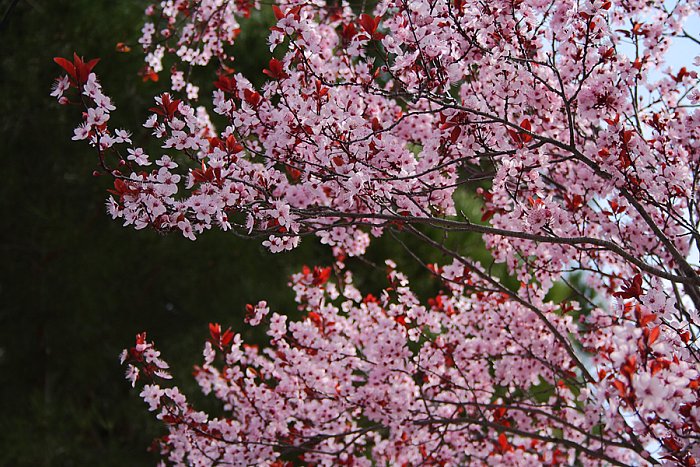
Purple-Leaf Plum and Cherry tree in flower.

This month the landscape is being painted with spring colours of blooming trees, and there’s a lot of hectic activity around them.

Trees are one of the most beautiful species in this world and some of my favourite creatures. Like the rest of the plants trees are producers, their waste product is oxygen that is indispensable for most life, while we are useless consumers smothering ourselves and consequently the planet with our waste product that is basically toxic shit. They provide shelter, food, medicines, shade, moisture, beauty, raw material for musical instruments among other countless things. And how do we treat them in return for their gifts? We fell, burn and poison them with contamination or pollution as sign of gratitude, which means we’re diligently digging our own grave.

Anyway, let’s enjoy their matchless beauty and hope they will survive in spite of us.
Purple-leaf plum or cherry plum (Prunus Pissardii Nigra) is a curious tree since it has reddish brown foliage. It's one of the first to flower in spring, and the flowers are usually pinkish white.


Purple-leaf plum in full blossom (Prunus Prissardii)
Purple-leaf plum in full blossom. (CC by-nc-sa )
Related Posts Plugin for WordPress, Blogger...