Catching the fleeting scenes of many splendored life
'Look closely. The beautiful may be small' — Kant

Showing posts with label Animals. Show all posts

4 January 2016

Birds of Prey. Laughing Kookaburra (Dacelo novaeguineae), American kestrel (Falco sparverius), Pied Crow (Corvus albus), Turkey vulture (Cathartes aura), Harris's hawk (Parabuteo unicinctus)

Laughing kookaburra (Dacelo novaeguineae) is a carnivorous bird in the kingfisher family Halcyonidae. The name is derived from Wiradjuri guuguubarra, onomatopoeic of its call which sounds like echoing human laughter. The birds are found in habitats ranging from humid forest to arid savanna, as well as in suburban areas with tall trees or near running water. Native to eastern Australia, they spread to parts of New Zealand, Tasmania, and Western Australia. The characteristic laughter serves to mark territorial borders. Most species of kookaburras tend to live in family units, with offspring helping the parents hunt and care for the next generation of offspring. Kookaburras are almost exclusively carnivorous and hunt by perching on a convenient branch or wire and waiting patiently for prey to pass by. Common prey include mice and similar-sized small mammals, large insects, lizards, small birds and nestlings, and even snakes, including venomous snakes much longer than their bodies. They can also snatch goldfish from garden ponds.
Chicks have a hook on the upper mandible, which disappears by the time of fledging. If there isn’t enough food, the chicks will quarrel, with the hook being used as a weapon, and the smallest chick may even be killed by its larger siblings. If food is plentiful, the parent birds spend more time brooding the chicks, so the chicks are not able to fight.

Laughing kookaburra (Dacelo novaeguineae). (© LightColourShade. All rights reserved)

13 December 2015

Elusive Guests. Black Rat (Rattus rattus), Water Rail (Rallus aquaticus) and Little Owl (Athene noctua)

Black rat (Rattus rattus, also known as the ship rat, roof rat, house rat, Alexandrine rat, old English rat, and other names) is a common long-tailed rodent of the genus Rattus (rats) in the subfamily Murinae (murine rodents). The species originated in tropical Asia (in India and Southeast Asia) and spread through the Near East and Egypt in Roman times before reaching Europe by the 1st century and spreading with Europeans across the world.
Black rats are generalist omnivores and thus not very specific in their food preferences, they feed on a wide range of foods, including seeds, fruit, stems, leaves, fungi, and a variety of invertebrates and vertebrates. Which makes them a kind of pest in nature (hmm, a lot in common with humans). They are vectors of many diseases including the bacterium Yersinia pestis, an agent of bubonic plague, (which I suspect is just another attempt to blame every mysterious disaster on an animal — the speed of propagation of the desease, as well as its geographic distribution raise doubts about the rodent’s role in the epidemics more likely caused, among other things, by the destruction of European forests, mini glaciation in the Middle Ages, overpopulation and consequent famine, and lack of hygiene).
Like tree squirrels rats prefer fruits and nuts. They are a threat to many natural habitats because they feed on birds and insects. They are also a threat to many farmers since they feed on a variety of agricultural-based crops, such as cereals, sugar cane, coconuts, cocoa, oranges, and coffee beans. The black rat is again largely confined to warmer areas, having been supplanted by the brown rat (Rattus norvegicus) in cooler regions and urban areas. In addition to being larger and more aggressive (I’ve seen big fat brown rats feed with chicken and porks at the same trough and chase cats), the change from wooden structures and thatched roofs to bricked and tiled buildings favored the burrowing brown rats over the arboreal black rats. In addition, brown rats eat a wider variety of foods, and are more resistant to weather extremes
Black rats adapt to a wide range of habitats. In urban areas they are found around warehouses, residential buildings, and other human settlements, especially in dry upper levels of buildings, so they are commonly found in wall cavities and false ceilings.. In agricultural areas they live in barns and crop fields. In the wild, black rats live in cliffs, rocks, the ground, and trees. They are great climbers and prefer to live in trees, such as pines and palm trees. We often see them in the neighbourhood walk up and down the trees and scutter along the power lines that serve as suspension bridges. Their nests are typically spherical and made of shredded material, including sticks, leaves, other vegetation, and cloth. In the absence of trees, they can burrow into the ground. Black rats are also found around fences, ponds, riverbanks, streams, and reservoirs.
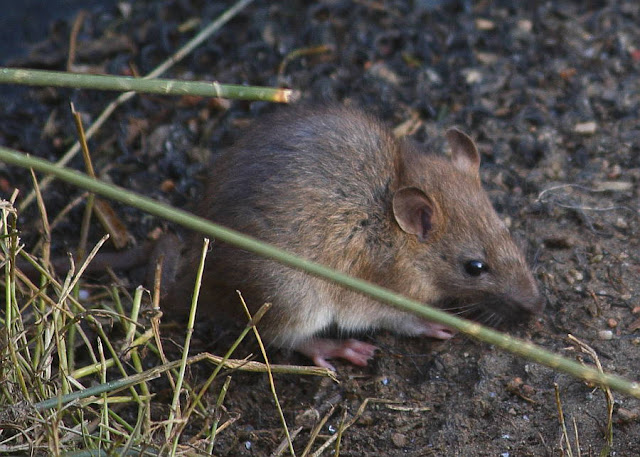
Black rat (Rattus rattus). (by-nc-nd)

24 June 2015

The Common Starling (Sturnus vulgaris) and Wood Pigeon (Columba palumbus).

The common starling (Sturnus vulgaris), also known as the European starling, is a passerine bird in the starling family, Sturnidae. It is about 20 cm (8 in) long and has glossy black plumage, which is speckled with white at some times of year. The legs are pink and the bill is black in winter and yellow in summer. It is a noisy bird, especially in communal roosts and other gregarious situations, with a varied song that sometimes sounds like a wolf-whistle. Its gift for mimicry has been noted in literature including the Mabinogion and the works of Pliny the Elder and William Shakespeare (hmm, that would explain the wolf-whistling). Large flocks of this species can be beneficial to agriculture by controlling invertebrate pests; however, starlings can also be pests themselves when they feed on fruit and sprouting crops.

Common starling (Sturnus vulgaris) on a twig.  (by-nc-nd)

19 June 2015

Yellowhammer (Emberiza citrinella) Female

Yellowhammer (Emberiza citronella) female in a puddle. (by-nc-nd)

25 May 2015

Rabbit suite. European rabbit or common rabbit (Oryctolagus cuniculus)

The European rabbit or common rabbit (Oryctolagus cuniculus) is native to south-western Europe (Spain and Portugal) and northwest Africa (Morocco and Algeria). The animal’s decline in its native range (caused by the diseases myxomatosis and rabbit calicivirus, as well as overhunting and habitat loss), has, in turn, caused the decline of its highly dependent predators, the Iberian lynx and the Spanish imperial eagle.”

European rabbit or common rabbit (Oryctolagus cuniculus) close-up. (© LightColourShade. All rights reserved)

9 February 2015

Homing pigeon (Columba livia domestica), Common Blackbird (Turdus merula), Eurasian Common Moorhen (Gallinula chloropus), Common Wood Pigeon (Columba palumbus), Common Pochard (Aythya ferina), and Great Cormorant (Phalacrocorax carbo)

Homing pigeon is a variety of domestic pigeon (Columba livia domestica) derived from the rock pigeon, selectively bred to find its way home over extremely long distances (up to 1,800 km). The wild rock pigeon has an innate homing ability, meaning that it will generally return to its nest and mate. Their average flying speed over moderate distances is around 80 km/h (50 miles per hour) but speeds of up to 140 km/h (90 miles per hour) have been observed in top racers for short distances. Homing pigeons are called messenger or carrier pigeons when they are used to carry messages. Pigeons can find their way back from distant places they have never visited before. Most researchers believe that homing ability is based on a "map and compass" model, with the compass feature allowing birds to orient and the map feature allowing birds to determine their location relative to a goal site (home loft). While the compass mechanism appears to rely on the sun, some researchers believe that the map mechanism relies on the ability of birds to detect the Earth's magnetic field. Scientists discovered on top of pigeon's beak large number of particles of iron which remain aligned to north like manmade compass, thus it acts as compass which helps pigeon in determining its home, and it looks like the trigeminal nerve plays a role in magnetoception, too. Some studies showed that pigeons also orient themselves using the spatial distribution of atmospheric odours, known as olfactory navigation, as well as low frequency infrasound. In areas they have previously visited, pigeons are probably guided by visual landmarks, such as roads and other man-made features, just like humans. However, various experiments suggest that different breeds of homing pigeons rely on different cues to different extents.

Homing pigeon (Columba livia domestica) portrait. (© LightColourShade. All rights reserved)

21 December 2014

European Robin (Erithacus rubecula)

European robin (Erithacus rubecula), is a small insectivorous passerine bird -- a chat that is now considered to be an Old World flycatcher. It is found across Europe, east to Western Siberia and south to North Africa. British robins are usually resident but a few, usually females, migrate to southern Europe during winter as far as Spain, while Scandinavian and Russian robins migrate to Britain and western Europe. These migrants can be recognised by the greyer tone of the upper parts of their bodies and duller orange breast. In autumn and winter, robins add to their usual diet of terrestrial invertebrates, such as spiders, worms and insects, berries, fruits or seeds. Despite their cute look, male robins show highly aggressive territorial behaviour not only attacking other males that stray into their territories, but also other small birds without apparent provocation.

While humanity is generally bedazzled by space exploration perceived as pushing new boundaries, I believe this planet contains the most inextricable mysteries of the Universe (unless there are more planets like earth), the great bulk of which is still beyond our ken -- after all Universe is a dark cold and deadly empty place. This tiny bird is one of such marvels -- like many other birds robins have the ability to sense the magnetic field of the earth for navigation which is affected by the light entering the bird's eye.
The physical mechanism of the robin's magnetic sense is not fully understood, some scientists even throw in theories like quantum entanglement of electron spins. There exist two main hypotheses to explain the phenomenon of magnetoreception in animals. One hypotheses holds that, cryptochrome, when exposed to blue light, becomes activated to form a pair of two radicals (molecules with a single unpaired electron) where the spins of the two unpaired electrons are correlated. The surrounding magnetic field affects the kind of this correlation (parallel or anti-parallel), and this in turn affects the length of time cryptochrome stays in its activated state. Activation of cryptochrome (a class of blue light-sensitive flavoproteins found in plants and animals. Cryptochromes are involved in the circadian rhythms of plants and animals, and in the sensing of magnetic fields in a number of species) may affect the light-sensitivity of retinal neurons, with the overall result that the bird can "see" the magnetic field. The Earth's magnetic field is only 0.5 Gauss and so it is difficult to conceive of a mechanism by which such a field could lead to any chemical changes other than those affecting the weak magnetic fields between radical pairs. (Cryptochromes are thought to be essential for the light-dependent ability of the fruit fly Drosophila melanogaster to sense magnetic fields.) According to another model, Fe3O4, also referred to as iron (II, III) oxide or magnetite, a natural oxide with strong magnetism remains permanently magnetized when its length is larger than 50 nm and becomes magnetized when exposed to a magnetic field if its length is less than 50 nm. In both cases the Earth's magnetic field produces a transducible signal via a physical effect on this magnetically sensitive oxide.

European robin (Erithacus rubecula). (by-nc-nd)

3 November 2014

Little Egret (Egretta garzetta garzetta) and Common Grasshopper Warbler (Locustella naevia)

Little Egret (Egretta garzetta garzetta) snapping fish
(© LightColourShade. All rights reserved)

19 September 2014

House Sparrow (Passer domesticus) Suite


House Sparrow (Passer domesticus) chick. (by-nc-nd)

10 August 2014

Tabby Cat on a Windowsill

Praying

Tabby cat looking out of the window. (by-nc-nd)

28 May 2014

Black Redstart (Phoenicurus ochruros) female

The Black Redstart (Phoenicurus ochruros) is a small passerine bird in the redstart genus Phoenicurus. Like its relatives, it's classed as a member an Old World flycatcher (Muscicapidae). It's widespread in south and central Europe and Asia and northwest Africa, from Great Britain and Ireland to Morocco, east to central China. It is resident in the milder parts of its range, but northeastern birds winter in southern and western Europe and Asia, and north Africa. It nests in crevices or holes in buildings. The Black Redstart is 13–14.5 cm long and weighs 12–20 g. The adult male is overall dark grey to black on the upperparts and with a black breast; the lower rump and tail are orange-red. The belly and undertail are either blackish-grey (western subspecies).. The female is grey (western subspecies) overall except for the orange-red lower rump and tail.
What I especially love about small birds is their cute and sweet contours.

Black Redstart (Phoenicurus ochruros) female with a rice grain. (by-nc-nd)

1 April 2014

Dragonflies. Crimson Marsh Glider (Trithemis aurora) and Violet Dropwing (Trithemis annulata)

The Violet Dropwing, Trithemis annulata, is a species of dragonfly in family Libellulidae.
It is found in Algeria, Angola, Benin, Botswana, Burkina Faso, Cameroon, Chad, the Democratic Republic of the Congo, Ivory Coast, Egypt, Ethiopia, France, Gambia, Ghana, Greece, Guinea, Israel, Kenya, Liberia, Madagascar, Malawi, Mali, Mauritius, Morocco, Mozambique, Namibia, Nigeria, Réunion, Senegal, Sierra Leone, Somalia, South Africa, Sudan, Tanzania, Togo, Uganda, Zambia, Zimbabwe, and possibly Burundi. It was also recently recorded in the Maltese islands in 2005 and found breeding in 2007.

Crimson Marsh Glider (Trithemis aurora) female on dry stalk. (by-nc-nd)

26 March 2014

Red-veined Darter, Nomad (Sympetrum fonscolombii) Male

Red-veined Darter, Nomad (Sympetrum fonscolombii) male on a dry stem.
 (© LightColourShade. All rights reserved)

17 February 2014

Clouded Yellow (Colias croceu), Large / Cabbage White (Pieris brassicae)

Clouded Yellow (Colias croceus) is a small butterfly of the Pieridae family. The upper side is golden to orange yellow with a broad black margin on all four wings and a black spot near the centre forewing. The underside lacks the black borders and is lighter, with a more greenish tint, particularly on the forewings. Females differ from the males in having yellow spots along the black borders on the upper side. Like all Colias species they never open their wings at rest.

Clouded Yellow (Colias croceu) on Dittrichia viscosa (False Yellowhead) flower. (by-nc-nd)

15 January 2014

Meerkat (Suricata suricatta) in a Cage

"What is it that should trace the insuperable line? ...The question is not, Can they reason? nor, Can they talk? but, Can they suffer?" Jeremy Bentham
Once again a sad sight -- an animal in confinement. Meerkat (Suricata suricatta), aka suricate or sticktail, is a small, burrowing, carnivorous mammal of southern Africa, related to the mongoose. Needless to say, such a frisky creature is a tricky subject for photography.

Meerkat (Suricata suricatta) in cage. (by-nc-nd)

10 December 2013

Eurasian Eagle-Owl (Bubo bubo), Great Grey Owl (Strix nebulosa), Harris Hawk (Parabuteo unicinctus), Spanish Imperial Eagle (Aquila+adalberti) and Turkey Vulture (Cathartes aura)

This post is a sort of collection of gazes, looks and stares.

The Eagle Owl has a wingspan of 160–188 cm (63–74 in). Females weigh 1.75–4.2 kg and males weigh 1.5–3 kg.

Thoughtful.
Eurasian Eagle-Owl (Bubo bubo) portrait. (© LightColourShade. All rights reserved) 

26 November 2013

Dragonflies. Red-veined Darter, Nomad (Sympetrum fonscolombii) female

The Red-veined Darter or Nomad (Sympetrum fonscolombii) is a dragonfly of the genus Sympetrum. It is widespread in southern Europe and from the 1990s onwards also in northwest Europe, including Britain and Ireland.

Red-veined Darter (Sympetrum fonscolombii) female.
(© LightColourShade. All rights reserved)

16 November 2013

Grey Heron (Ardea cinerea), Great Cormorant (Phalacrocorax carbo) and Little Egret (Egretta garzetta garzetta)

The Grey Heron (Ardea cinerea), is a wading bird of the heron family Ardeidae, native to temperate Europe, Asia and parts of Africa. It is resident in the milder south and west, but many birds migrate in winter from colder regions. It is a large bird, measuring 84–102 cm (33–40 in) long with a 155–195 cm (61–77 in) wingspan and creating an impressive hovering silhouette against the sky. Unlike storks, cranes and spoonbills which extend their necks in flight, grey heron flies slowly with its long neck retracted (S-shaped), which is characteristic of herons and bitterns. However I captured this one flying with its neck outstretched (and performing acrobatics in the air), apparently because the bird was trying to eat the fish it was holding in its claws.

Grey Heron (Ardea cinerea) in flight with its neck extended
(© LightColourShade. All rights reserved)

13 November 2013

Dragonflies. Lesser Emperor (Anax parthenope)

The Lesser Emperor (Anax parthenope) is a dragonfly of the family Aeshnidae found in Southern Europe, north Africa and Asia.

Lesser Emperor (Anax parthenope) on dry grass stalk
(© LightColourShade. All rights reserved)
Related Posts Plugin for WordPress, Blogger...